DCDHS Language Access Coordinators developed this action plan, related procedures, and interpreting resources to support compliance with applicable federal, state, and local requirements. [1] These materials reaffirm DCDHS’s commitment to meaningful access for individuals with limited English proficiency, effective communication for people with disabilities, and accessible communication practices, including digital accessibility consistent with WCAG and ADA requirements. [2] Together, they help community members understand their rights and available accommodations while equipping DCDHS staff to provide communication services effectively and consistently. [3]
All Dane County Department of Human Services (DCDHS) programs and offices must make every effort to provide appropriate language assistance services at no cost to all visitors and callers. DCDHS must ensure that individuals who need language assistance have meaningful access to all programs and services, including information delivered through outgoing messages on public contact telephone lines.
At the initial point of contact with someone who might need language assistance, DCDHS staff will use Language Access Signs and Notices created by DCDHS Language Access Coordinators to identify the person’s primary language. These tools will be available in all public-facing lobby and reception areas.
DCDHS Staff may identify whether an individual may need language assistance in several ways, including but not limited to:
Based on U.S. Census data, English and Spanish are the most commonly spoken languages in Dane County.[4] Materials that meet at least one of the criteria below should be provided in both English and Spanish.
Dane County Department of Human Services (DCDHS) is responsible for taking reasonable steps to ensure meaningful access to information, programs, and services for all residents and visitors. This includes notifying current and potential residents and visitors that language assistance is available at no cost.
All public facilities must display appropriate language access signage so residents and visitors know how to request language assistance services. To reduce errors when identifying an individual’s primary language, DCDHS staff should obtain approved signs, posters, icon images, and language identification cards through the DCDHS intranet or by contacting the Language Access Coordinators at hslanguageservices@danecounty.gov.
All DCDHS program offices should post exterior language access signage in English, Spanish, and Hmong, whenever possible. Additional languages may be posted as needed; suggested (but not required) languages include Chinese, Arabic, Russian, Korean, and Vietnamese.
Interior signage should help direct residents and visitors to key service locations, such as reception areas/help desks, as well as restrooms. Interior signage should also include required regulatory or safety notices (e.g., evacuation routes, no-smoking notices, and other posted restrictions).
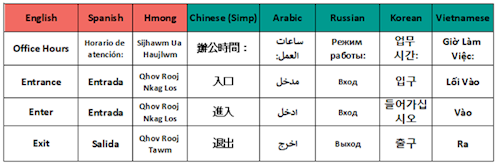
DCDHS program offices should use wayfinding signage to provide directions within buildings (e.g., to restrooms, child care/daycare areas, meeting rooms, and other public-facing services). Offices may use the language preference chart to select the preferred languages for wayfinding signs.
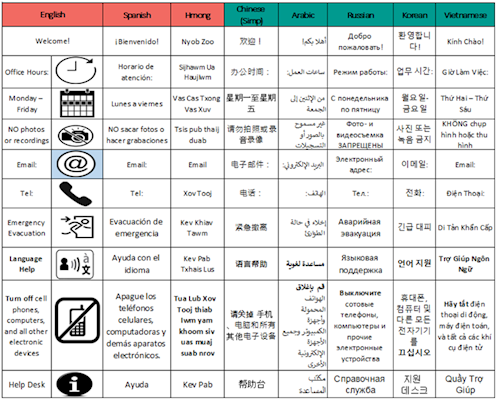
All DCDHS program offices should display the Your Right to an Interpreter Poster created by the Wisconsin Department of Health Services (DHS), the Wisconsin Department of Children and Families, and the State of Wisconsin Department of Workforce Development (DWD).[5]
This poster instructs multilingual individuals to point to their language
All DCDHS program offices must display an “I Speak…” flyer at each reception or customer service window. [1]
The “I Speak…” tool is a poster, flyer, or wallet-sized identification card designed to help staff identify the primary language of individuals who do not speak English proficiently. Residents or visitors are to point to their language from a list of 60+ languages and show their selection to the staff member assisting them, making it easier to communicate in their preferred language and enabling staff to connect them with appropriate language assistance. I Speak... Language Identification Guide
Interpretation services are available to DCDHS staff who need oral language support when communicating with Dane County residents who prefer to speak in their primary language. DCDHS works with language service providers and employs qualified, certified interpreters to support all divisions, programs, and offices.
To help manage costs and meet demand, DCDHS hired two Spanish-certified interpreters to handle requests in Spanish. Our in-house Spanish interpretation services are available Monday through Friday, 8:30 a.m. to 5:00 p.m. Availability may vary, so please submit requests as early as possible. If interpretation is needed outside regular hours, the following options are available: 1. Reschedule the appointment, 2. Phone interpretation (Language Line), 3. Hire an external vendor.
DCDHS staff may use phone, video, or in-person interpreting when working with residents who need language support. Staff can contact the Language Access Coordinators for help choosing or arranging the best option
DCDHS contracts with LanguageLine Solutions to provide on-demand over-the-phone interpretation. Interpreters are available 24/7/365 with over 290 languages.
Instructions for Phone Interpreting:
Please make sure to put your caller on hold, or conference in your caller before calling LanguageLine Solutions.
| Division | 6-Digit Client ID |
|---|---|
| ADMIN | 709156 |
| ADRC | 531369 |
| BH | 707308 |
| BH CCS | 707320 |
| BHRC | 661464 |
| BPHCC | 706268 |
| CYF | 531398 |
| DAS AAA | 652562 |
| DAS ACS | 531094 |
| DAS Admin | 707303 |
| EAWS | 531092 |
| HAA | 707318 |
| PEI | 707316 |
DCDHS also contracts with LanguageLine Solutions to provide on-demand video interpretation. Interpreters are available 24/7/365 with over 290 languages.
Every division will work with the Language Access Coordinator to set up and activate the video interpreting features on DCDHS devices. Language Access Coordinators can be reached at hslanguageservices@danecounty.gov.
Video Remote Interpreting Procedure at a Glance
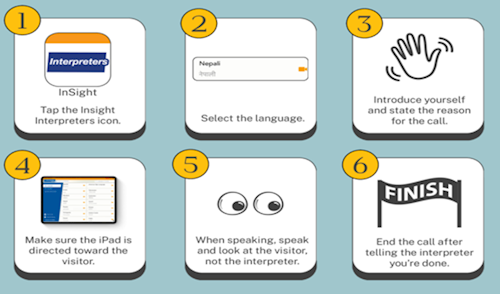
DCDHS encourages in-person interpreting with all planned appointments as much as possible because it enhances accuracy by allowing staff to recognize non-verbal cues, body language, and cultural nuances that are not readily apparent in phone or video interpreting services. People are also better engaged and build trust quickly with in-person interpreting. The likelihood of obtaining an in-person interpreter is often best through advance planning rather than same-day or urgent requests, as coordinating an interpreter for an in-person appointment takes time to set up due to the need to locate an available interpreter.
Urgent Request: DCDHS staff are to use the Video Remote Interpreting (VRI) or Phone Interpreting services for immediate or emergency situations that cannot be assigned within the request time. As VRI and Phone services are accessible 24/7 and available to serve urgent needs with a response time of 30 seconds or less.
There are exceptions for urgent Spanish in-person interpreting, since DCDHS has on-site Spanish interpreters who can respond more quickly to urgent situations.
Instructions for Requesting In-Person Interpreting:
Step 1: Gather key appointment details before submitting a request.
Step 2: Complete the DCDHS Language Access Qualtrics form found on the intranet or scan the QR code below.
https://countyofdane.qualtrics.com/jfe/form
Step 3: You will receive an email confirmation within 24 hours acknowledging receipt of your request.
Interpretation Request: You will receive an additional email confirming the assigned interpreter's name and contact information.
The Language Access Coordinator or Spanish Interpreters will respond within 1 business day to confirm receipt of the request and start locating an available interpreter for the requested language.
The Language Access Coordinators have established a process to ensure that all written materials are translated by qualified language POS providers or translators.
DCDHS uses complex terms, acronyms, and jargon that can seem unfamiliar to the general public. To ensure people with limited English receive accurate information, when possible, Hmong- and Spanish-translated materials will be reviewed by DCDHS bilingual Hmong and Spanish Language Access Coordinators who are proficient in these languages and have experience and knowledge of the various DCDHS programs. This review ensures that the translations align with DCDHS language standards and maintain the original content meaning as intended by the requester.
Instructions for Requesting Translations:
Step 1: Complete the DCDHS Language Access Qualtrics form found on the intranet or scan the QR code below. And attached editable documents to the request.
https://countyofdane.qualtrics.com/jfe/form
Step 2: You will receive an email confirmation within 24 hours acknowledging receipt of your request.
Translation Request: You will receive the completed translation by the requested due date.
The Language Access Coordinator or Spanish Interpreters will respond within 1 business day to confirm receipt of the request and start locating an available interpreter for the requested language.
Recordkeeping of Translations
All translated requests will be documented in a central recordkeeping system. The record will be properly stored by Human Services.
All documents can be tracked and easily located by searching for the assigned Qualtrics Job ID, Division, and Program. Both the original document and the complete translated version(s) will be saved together. DCDHS personnel will have access to the central record and database of all translated materials.
DCDHS recognizes that working with interpreters is new and can be challenging for many professionals, especially when staff have had limited formal training in collaborating effectively with interpreters in community and educational settings.
In addition to providing Language Access training within DCDHS, to help DCDHS staff work effectively with interpreters and promote inclusivity and equity for community members who speak languages other than English, Language Access Coordinators have developed the Working with an Interpreter Guide and the In-person Interpretation Service Agreement. These resources are intended for in-person interpreter appointments to support staff, interpreters, and clients.
The Interpretation Service Agreement must be signed by the staff member, the interpreter, and the client to ensure everyone has read and understands DCDHS expectations for collaboration. Promoting accurate communication, cultural respect, and a shared understanding of each person’s role. Together, these practices can strengthen trust in language access services and encourage both staff and clients to use them. They can be found on the DCDHS intranet or by contacting Language Access at HSlanguageservices@danecounty.gov.
Before the Interpretation:
During the Interpretation:
After the Interpretation:
The Economic Assistance and Work Services Division (EAWS) runs a call center for participants in Income Maintenance and Work Services programs, including FoodShare, Medical Assistance, Child Care, Emergency Assistance, the Refugee Assistance Program, and FoodShare Employment and Training. Callers can choose English, Hmong, or Spanish through the phone system. Calls in Hmong or Spanish are directed to bilingual staff members who speak those languages.
Consult/Conference 3rd Parties Language Line
Notes and Reminders:
[1] Title VI of the Civil Rights Act of 1964, 42 U.S.C. 2000d et seq.; Exec. Order No. 13166, 65 Fed., Reg. 50121 (August 16, 2000); Wis. Stat. 46.2895.
[2] Americans with Disabilities Act of 1990, 42 U.S. C. 12101 et seq.; 28 C.F.R. pt. 35; U.S. Department of Justice, “ADA Requirements: Effective Communication, “accessed April 6, 2026.
[3] Web Content Accessibility Guidelines (WCAG) 2.1, World Wide Web Consortium (W3C), June 5, 2018; Nondiscrimination on the Basis of Disability in State and Local Government Services, 28 C.F.R. pt. 35.
[4] U.S. Census Bureau, American Community Survey (ACS), language spoken at home data for Dane County, Wisconsin.
[5] Wisconsin Department of Health Services, Wisconsin Department of Children and Families, and Wisconsin Department of Workforce Development, Your Right to an Interpreter (poster), accessed April 7, 2026, https://www.dhs.wisconsin.gov/publications/p0/p00417.pdf.
[6] Ohio Office of Criminal Justice Services, I Speak… Language Identification Guide (April 2006), accessed April 7, 2026, available via Office of Justice Programs, https://www.ojp.gov/ncjrs/virtual-library/abstracts/i-speaklanguage-identification-guide. (ojp.gov)